
Codex vs Claude Code: Which AI coding agent should you use?
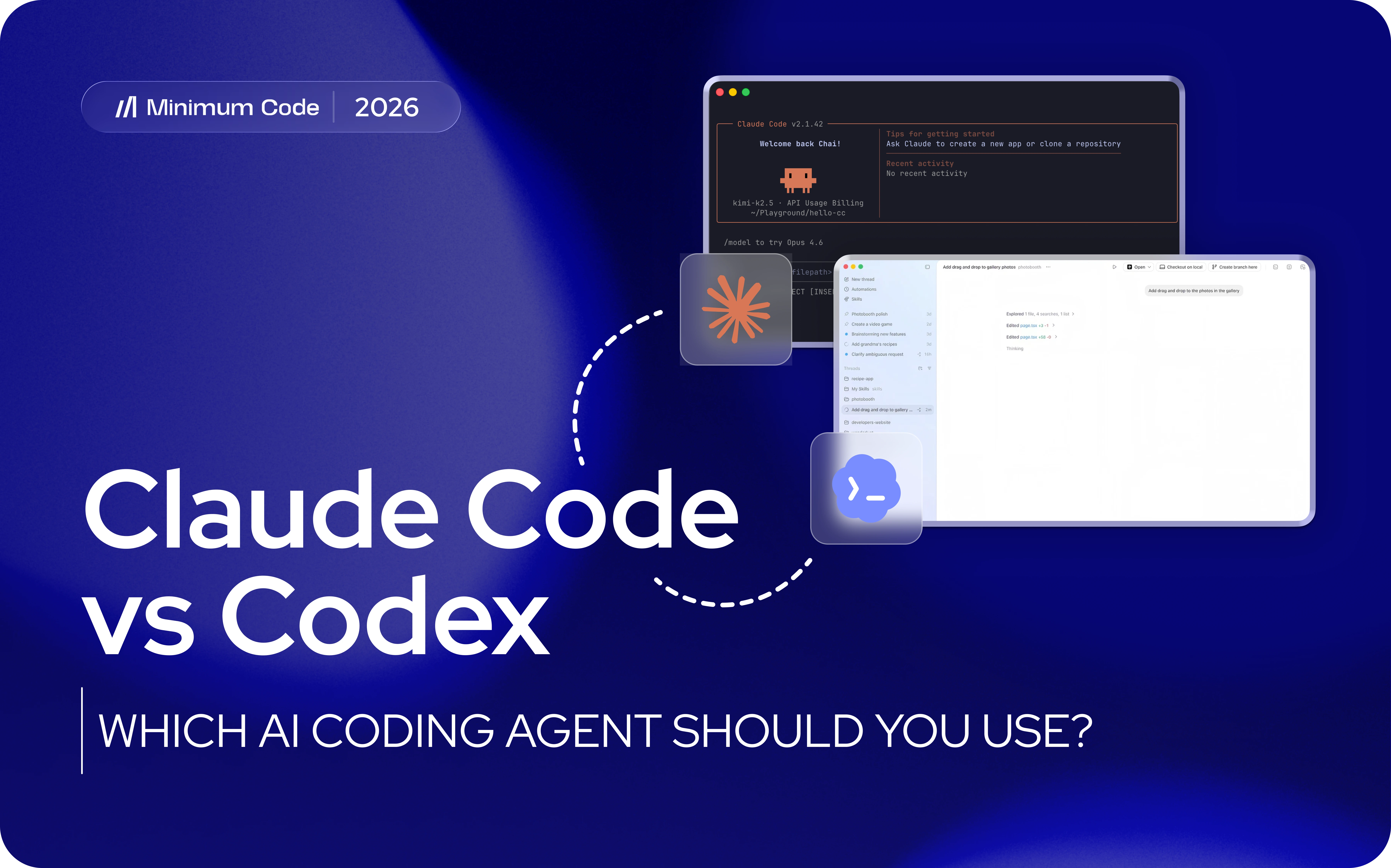

The Codex vs Claude Code decision is no longer a simple contest between two assistants that suggest snippets. In 2026, both products can inspect a repository, plan changes, edit multiple files, run commands, test their work and prepare code for review. The practical choice comes down to how your team wants to direct, supervise and verify autonomous engineering work.
For most founders, the answer is clear enough to act on. Claude Code is an excellent fit for an engineer who wants a powerful agent embedded in a hands-on development workflow. Codex is particularly compelling when a team wants to coordinate several tasks across local and cloud environments, keep work separated and supervise longer-running jobs. Neither removes the need for architecture, testing, security review or technical ownership. That is why our software development approach treats coding agents as delivery infrastructure under senior engineering control.
Key takeaways
- Codex is strongest for coordinating parallel tasks, cloud execution and longer-running agent work across several interfaces.
- Claude Code is especially effective for deep, engineer-led work inside existing repositories and terminal-based workflows.
- Both tools can inspect codebases, implement features, run tests and prepare changes for review.
- The better choice depends more on workflow, repository quality and technical supervision than temporary benchmark differences.
- Neither tool replaces architecture, security checks, testing, code review or accountable technical ownership.
- Founders should evaluate total delivery performance, including review time, defects and rework, instead of focusing only on subscription price or generated code volume.
- Codex suits teams that want to delegate several clearly separated jobs and review the results asynchronously.
- Claude Code suits developers who expect to investigate, intervene and refine decisions throughout an active coding session.
- Some mature teams may use both tools, assigning each one to the tasks that best match its operating model.
What are Codex and Claude Code in 2026?
Codex and Claude Code are agentic software development tools. You give them a goal, access to a codebase and operating constraints. They can then investigate the project, propose or execute a plan, change code, run tests and report what happened. Their value comes from completing bounded engineering work, not only from merely predicting the next line in an editor.
Codex has become a control surface for engineering agents
OpenAI Codex now spans a desktop app, command-line interface, IDE extension and cloud execution. Work can be organised into separate tasks, with isolated working copies helping multiple agents operate without colliding.
Skills add reusable instructions and workflows. Automations can schedule recurring jobs such as issue triage or checking continuous integration failures. Mobile access also lets a person review progress, answer questions and redirect active work away from their desk.
That product shape matters. A developer can still use Codex as a close coding partner, but the wider proposition is supervision at scale. One person can investigate a bug locally while other agents prepare tests, review another change or work in parallel on a separate feature.
Claude Code starts from the developer's working environment
Claude Code grew from a terminal-first workflow and remains closely aligned with how experienced engineers navigate a repository. It can read the project, modify files, run development tools, work with version control and connect to external systems. It supports reusable project instructions, hooks, specialised subagents and Model Context Protocol integrations, giving teams substantial control over how the agent behaves.
Claude Code is available through more than a single terminal session, but its centre of gravity still feels engineer-led. The person operating it stays close to the code, commands, tests and decisions. That directness is valuable when the task is ambiguous, the codebase has history or the engineer expects to intervene frequently.
Codex vs Claude Code at a glance
Both agents cover the core implementation loop well, so a feature checklist quickly becomes misleading. The better comparison is the operating model each encourages.
Both platforms are developing quickly, and the result of a real task also depends on the selected model, repository quality, instructions, tools, permissions and review process.
Codex pros and cons
- Pros: Clear multi-task supervision, isolated work for parallel agents, local and cloud execution, reusable skills, scheduled automations and several ways to review or redirect work.
- Cons: Parallel capacity can create a review backlog, the broader operating model takes time to configure well, and asynchronous work still needs precise scope and acceptance criteria.
Claude Code pros and cons
- Pros: Excellent fit for deep repository sessions, close interaction with development tools, flexible project instructions, hooks and specialised agents, plus strong integration options.
- Cons: The terminal-centred workflow assumes technical confidence, long interactive sessions can consume focused engineering attention, and extensive customisation can become difficult to govern across a team.
Where Codex has the stronger workflow
Codex is strongest when engineering work benefits from explicit separation, delegation and asynchronous supervision. Its 2026 product direction treats the agent as a worker that can operate across different surfaces while a human remains responsible for review.
Parallel work is easier to see and coordinate
The Codex app is designed around multiple tasks rather than one continuous chat. Separate threads preserve context, and isolated working copies reduce the chance that two jobs overwrite each other's changes. This is useful when a small team needs to move several independent pieces of work forward at once.
Imagine a release with a payment bug, a missing test suite and a small onboarding change. Those jobs can be separated, reviewed independently and merged deliberately. The organisational advantage is often more valuable than a small difference in generated code quality.
Our guide to software development outsourcing reaches a similar conclusion from a team perspective: capacity only helps when ownership, scope and review responsibilities remain clear. Agents create additional execution capacity, so they amplify good coordination and expose weak coordination faster.
Cloud and background work suit longer tasks
Codex can execute work in the cloud and continue while the operator focuses elsewhere. Automations add scheduled, repeatable work. This makes it a natural candidate for repository maintenance, issue triage, documentation upkeep, routine checks and other tasks with a clear success condition.
Founders should care because interruptions are expensive. A capable engineer who has to watch every command loses much of the promised productivity gain. Asynchronous execution can return that attention, provided the task is constrained and the output enters a review queue before it reaches users.
The wider OpenAI workflow reduces operational friction
Teams already using ChatGPT and OpenAI tools may find Codex easier to adopt across roles. The same work can move between local projects, cloud jobs and supervisory interfaces. Skills can package team-specific instructions so repeated tasks start with a stronger operating context.
This is especially relevant when software work touches research, documentation, product operations or deployment. The Minimum Code AI coding service uses both Codex and Claude Code within an engineering process, because tool choice follows the work rather than becoming a company identity.
Where Claude Code shows the stronger workflow
Claude Code is particularly persuasive when an experienced developer wants an agent embedded in a focused, iterative coding session. Its workflow gives the operator a direct relationship with the repository and the tools already used to understand it.
It feels natural for deep repository work
Large existing systems rarely yield to a single clean prompt. The engineer needs to trace behaviour, inspect dependencies, test assumptions and revise the plan as the code reveals more context. Claude Code's terminal-centred experience supports this investigative rhythm well.
That makes it attractive for refactoring, debugging and changes that cross several layers of an application. The quality still depends on the person directing the work. A coherent repository with useful tests and documented conventions gives the agent far better evidence than an inconsistent project with hidden business rules.
Founders inheriting an uneven application should start with diagnosis. Our article on custom software development explains why architecture, integrations and operating requirements need to be understood before a team commits to a rebuild or major extension.
Extensibility can enforce a disciplined local workflow
Claude Code supports project instructions, hooks, specialised agents and connections to external tools. A team can use these controls to run checks, preserve conventions and bring relevant systems into the development loop. That creates a repeatable environment around the model rather than relying on a perfect prompt every time.
Hooks and permissions deserve careful design. Powerful automation can make a good process faster, but broad access also increases the cost of a mistaken instruction or compromised dependency. Teams should grant the smallest practical permissions and keep sensitive actions behind explicit approval.
Enterprise model access fits existing infrastructure choices
Claude Code can use Anthropic directly and supports enterprise deployment routes through major cloud providers. For organisations with established procurement, identity and cloud controls, this can simplify adoption. The decision may be driven by governance and data handling long before developers compare the tools' interface details.
This is one reason a universal winner would be unhelpful. Procurement constraints, repository location, security policy and existing vendor commitments can outweigh marginal differences in model behaviour.
Which tool is better for your product stage?
The product stage changes the job you are hiring the agent to do. A prototype needs fast learning, and a live application needs controlled change and predictable recovery. The same tool can serve both, but the supervision burden rises sharply once real operations depend on the software.
Early prototype: choose the workflow you can supervise
For a technical founder or senior developer, either tool can accelerate scaffolding, integrations, interface work and early tests. Claude Code may feel more immediate for one engineer exploring a codebase. Codex may be more useful when exploration can be split into independent tasks or combined with research and documentation.
A non-technical founder can still use these products to learn and prototype, but code appearing on screen is a weak definition of progress. Authentication, data access, error handling and deployment behaviour remain easy to miss. Our comparison of AI app builder platforms helps clarify when a more guided builder is a better match for early validation.
MVP approaching launch: optimise for verification
As the product approaches launch, the winning agent is the one operating inside the better engineering system. Requirements should be specific enough to test. Changes should remain small enough to review. Automated checks should cover important user journeys, and a human should verify the product in a realistic environment.
This is also the stage where founders tend to confuse speed with readiness. The MVP development process explains how discovery, scoping, implementation, testing and launch support fit together. Coding agents can compress parts of that process, but they do not erase the dependencies between them.
Live product: favour control, traceability and recovery
For a product with paying customers, the tool should fit your release controls. Every material change needs an owner, a readable diff, test evidence and a rollback path. Access to production data or infrastructure should be restricted and audited.
Codex's task separation is useful for creating reviewable units of work. Claude Code's close engineer interaction is useful for ambiguous incidents and careful repository changes. Many mature teams will use both, assigning work according to risk and working style.
What founders should check beyond the model
Model quality changes frequently and varies by task. A procurement decision based on one benchmark or viral demo can be obsolete before the workflow is fully adopted. Founders will get a more durable answer by evaluating the surrounding delivery system.
Repository context and written standards
Agents make better decisions when the codebase explains itself. Clear setup instructions, architecture notes, naming conventions and test commands reduce guesswork. A well-maintained project also makes human review faster because the intended patterns are visible.
This documentation has commercial value. It reduces dependence on individual developers and lowers the cost of future changes. If an agent repeatedly needs long corrective prompts, the repository may be missing durable instructions that belong in the project itself. Also, time is money.
Testing and review capacity
Faster implementation creates more output to inspect. A team can easily become code-rich and review-poor, with unfinished changes accumulating faster than anyone can verify them. The bottleneck then moves from writing code to making confident release decisions.
The most useful metrics are operational: review time, escaped defects, failed deployments, recovery time and rework. Our collection of software development statistics explores why AI-supported delivery pushes more pressure into review, QA, security and maintenance.
Security and permission boundaries
Both tools can run commands and change a repository, which is exactly why permission design matters. Start with restricted access, isolate experimental work, protect secrets and require approval for network, deployment and destructive actions.
Generated code should pass the same dependency, security and privacy checks as human-written code.
European founders also need to consider personal data, vendor terms, data location and the systems connected through plugins or external tools. GDPR responsibility remains with the business using the software. An agent's speed has no bearing on that obligation.
Pricing in the context of total delivery cost
Subscription or usage pricing is only one line in the budget. The larger costs are engineering time, review, rework, infrastructure, incidents and delayed learning. A tool that appears cheaper can become expensive if it produces changes your team cannot confidently understand or maintain.
Evaluate both agents on representative tasks from your own repository. Track the time required to clarify the task, run it, review the result, correct mistakes and reach a releasable change. That end-to-end measure is more commercially meaningful than tokens consumed or code generated.
Can either tool build production software without a developer?
Neither Codex nor Claude Code should be treated as an autonomous replacement for technical ownership. They can produce substantial working software, but production readiness includes decisions that sit outside code generation: architecture, threat modelling, data protection, release design, monitoring, recovery and long-term maintenance.
A non-technical founder may get surprisingly far with a clear product and modern agent. The danger is that visible progress hides invisible risk. A login flow can work while exposing another user's records. A payment can complete while retry behaviour creates duplicates. A feature can pass a happy-path demo while failing under ordinary operational conditions.
The practical model is agentic engineering. Agents handle investigation and implementation under constraints. Senior engineers own the system design, review the changes and decide what ships. That keeps the speed advantage while preserving accountable judgment.
The path also depends on what you are building. Our custom code versus visual development comparison explains how product complexity, flexibility, ownership and maintenance affect the underlying build approach. Coding agents improve the economics of custom development, but they do not make every product architecture equally sensible.
How to choose between Codex and Claude Code
Run a short, controlled evaluation using real work. Avoid asking each tool to create a toy application, because greenfield demos hide the context and review demands that dominate ongoing development.
Use three tasks: one contained bug with a known expected result, one feature that crosses the interface and backend, and one investigation where the correct solution is not obvious. Give both agents the same repository guidance and permission boundaries. Then compare the accuracy of the diagnosis, quality of the plan, size and clarity of the change, test evidence, review effort and number of corrections required.
Choose Codex when parallel task management, isolated work, cloud execution and asynchronous supervision materially improve your team's throughput. Choose Claude Code when the primary user is an engineer who wants a direct, highly configurable agent inside a deep repository workflow. Keep both when different classes of work justify the operational overhead.
The rollout should remain narrow at first. Define which repositories and environments the agent may access, with production permissions excluded by default. Require human review and passing tests before every merge, then measure rework and escaped defects. Store project instructions with the repository and improve them when the same correction appears more than once.
Once the team can show that changes reach production faster without increasing defects or recovery time, broaden the workflow. Adoption should follow evidence from your delivery system.
Frequently asked questions
This comparison moves quickly, so these answers focus on the durable product and workflow differences that matter to founders.
Is Codex better than Claude Code?
Codex is the better fit for teams that value multiple parallel tasks, isolated work, cloud execution and supervision across several interfaces. Claude Code may be the better fit for an engineer who wants close, iterative control in a terminal-centred workflow. Code quality depends heavily on the task, model, repository context and review process.
Is Claude Code only a command-line tool?
Claude Code's identity began in the terminal, but the product reaches into IDE, web and desktop workflows as well. The command line remains important because it places the agent beside the repository, version control, tests and development commands.
Can Codex and Claude Code work on an existing codebase?
Yes. Both can inspect and change existing repositories. Results improve when the project has clear setup instructions, documented conventions and reliable tests. Legacy systems with hidden rules still require careful investigation and experienced review.
Which is safer for a startup?
Safety depends more on configuration and process than the product name. Restrict permissions, protect secrets, isolate agent work, review diffs, run automated checks and keep deployment approval with a responsible person. The safer tool is the one your team can govern consistently.
Should a small team pay for both?
Usually, start with one. Select the tool that fits the main operator and run it on representative work. Add the second when a specific workflow advantage justifies extra cost, training and governance. Paying for overlapping capability without a clear operating reason creates more complexity than value.
The verdict for founders
In the 2026 Codex vs Claude Code comparison, Codex leads for orchestrating parallel and asynchronous agent work, while Claude Code remains a superb choice for deep, engineer-led repository sessions. Either can accelerate delivery inside a disciplined process. Neither turns unsupervised code generation into accountable product engineering.
If you need to choose the workflow, architecture and level of technical oversight for a real product, talk to Minimum Code. We will give you a practical view of what can be accelerated, what needs senior ownership and the safest route to launch.
.avif)


Explore related articles

Ready to build your product?