
Website Development Cost 2026: Full Price Breakdown for Founders

Wondering what the real cost of website development 2026 will look like? With average build prices rising over 15 percent in the past three years, it is no surprise founders worry about budgets, hidden fees, and fast-changing tech.
This guide breaks down every factor that could influence the cost of website development 2026. You will see how your tech choices, team structure, design, and ongoing support all affect your final budget.
We will explore the main cost drivers, compare website types, look at new trends like AI and no-code, and share practical tips for budgeting. By the end, you will have the clarity to plan smarter and make confident decisions for your next project.
Key Factors Influencing Website Development Costs in 2026
Understanding the key factors behind the cost of website development 2026 will help you make informed choices and budget more effectively. Each project is unique, but several universal drivers shape pricing and complexity for founders planning to launch in Europe.

Complexity and scope of the project
The complexity and scope of your website are the foundation for the total cost of website development 2026. A simple brochure site with a few pages and a contact form is much less expensive than a feature-rich e-commerce shop or a SaaS platform.
As you add features like payment processing, user accounts, or custom dashboards, costs rise. Integrations with third-party tools or bespoke workflows also have a direct impact. User experience (UX) and accessibility are no longer optional for European founders: meeting WCAG and local accessibility guidelines may require extra design and development time.
For example, an e-commerce site with advanced search or multi-language support will cost more than a static marketing website. Clear project scope helps avoid expensive surprises.
Technology stack and platforms
The technology stack you choose is a major factor in the cost of website development 2026. Today, options range from traditional coding (React, Vue) to established CMS platforms (WordPress) and modern no-code/low-code tools like Webflow and Bubble.io.
No-code and low-code platforms promise faster delivery and lower costs, especially for MVPs. However, highly customised features might still require custom code. AI tools and automation are also becoming standard, further shaping budgets.
Comparing costs between platforms is crucial. For instance, Webflow vs Bubble Cost Comparison provides a useful breakdown of cost and flexibility, helping you select the right approach for your needs.
Team structure and location
Who builds your website, and where they are based, directly affects the cost of website development 2026. You can hire freelancers, assemble an in-house team, or work with an agency. Each model has trade-offs in cost, communication, and expertise.
Location also matters. European agencies often charge €60–€120 per hour, while Eastern European teams may offer similar skills at €30–€60. Rates in Asia can be lower, but founders should consider time zones, communication, and support quality.
For self-funded founders, a blend of local project management and offshore development can balance costs and outcomes.
Design and branding requirements
Your approach to design and branding can shift the cost of website development 2026 significantly. Using pre-made templates is budget-friendly, but custom UI/UX design, branding, and prototyping (using tools like Figma) will increase costs.
Design expenses typically make up 15–30 percent of the total budget for new websites. Investing in a strong brand and user experience pays off in credibility and conversion rates. However, if your MVP only needs a simple interface, starting with templates can reduce upfront spend.
Always clarify your design needs early, as changes late in the process can trigger additional fees.
Security, compliance, and scalability
Security and compliance are critical for any European founder. Meeting GDPR, local privacy laws, and accessibility standards is not optional and directly relates to the cost of website development 2026.
Planning for scalability is vital. An MVP might use basic hosting, but as your user base grows, you will need secure infrastructure and regular compliance audits. For example, secure hosting and annual GDPR reviews can add several thousand euros per year.
Neglecting these areas can lead to costly fixes or even legal penalties later, so factor them into your initial budget and roadmap.
Website Development Cost Breakdown by Type
Understanding the cost of website development 2026 means looking at each major website category. The price you pay will depend on your project type, features, and how you choose to build. Below, we break down the typical costs and drivers for each kind of site.

Brochure and marketing websites
Brochure sites are the simplest option for most founders. They usually include a few pages, a contact form, and sometimes a blog. In 2026, the cost of website development 2026 for a basic 5 page Webflow site with a CMS typically ranges from €2,000 to €6,000.
Adding animations, custom branding, or advanced content management can raise prices. Using templates can reduce costs, but unique design and accessibility standards increase them. For founders on a tight budget, this type offers a fast, affordable route.
E-commerce websites
E-commerce sites require features like product catalogues, shopping carts, payment gateways, inventory, and shipping integrations. The cost of website development 2026 for e-commerce varies by platform and complexity.
A Shopify build with standard features may cost €5,000 to €15,000. WooCommerce sites fall in a similar range, but custom solutions can exceed €20,000. Adding multi-language support or advanced inventory tools increases costs further. In Europe, average e-commerce builds are trending higher as privacy and payment compliance needs grow.
SaaS and web applications
SaaS and web apps demand user accounts, dashboards, and third party integrations. The cost of website development 2026 for a no-code MVP using Bubble.io is often €8,000 to €20,000, while custom code can start at €25,000.
Many founders choose no-code for speed and budget control. If you want a step-by-step walkthrough, our guide on how to build an MVP app with no-code tools covers the full process from feature prioritisation to launch in 4–6 weeks.
Features like real time data, complex workflows, or secure authentication drive costs up. For a deeper dive, see this Website Cost Breakdown 2026 for up to date pricing data.
Marketplaces and multi-sided platforms
Marketplaces are complex, with multiple user roles, payments, messaging, and review systems. The cost of website development 2026 for a two sided marketplace can start at €20,000 for an MVP, but often climbs to €50,000 or more with advanced features.
Key cost multipliers include real time chat, escrow payments, and custom matching logic. Founders should budget for extra testing, compliance, and scalability planning, as these platforms must handle more users and data.
Mobile-friendly and responsive sites
Every site needs to be mobile responsive in 2026. The cost of website development 2026 for mobile-first design is now standard, but building complex mobile interactions or progressive web apps can add 10 to 20 percent to your budget.
User behaviour trends show over 70 percent of visitors in Europe start on mobile. Investing in mobile usability is critical, and founders should prioritise testing on multiple devices to avoid costly fixes later.
Ongoing maintenance and support
After launch, ongoing costs are essential to plan for. The cost of website development 2026 includes not just the initial build, but also hosting, security updates, bug fixes, and new features.
Annual maintenance packages for startups typically range from €1,000 to €5,000. Scaling up, adding integrations, or meeting new compliance rules can increase this. Ignoring maintenance risks downtime and lost revenue, so budgeting for support is non negotiable.
Emerging Trends Impacting Website Costs in 2026
Staying ahead of the curve is critical when planning for the cost of website development 2026. New trends are not just shaping how websites are built, but also directly impacting what founders should expect to pay. Let us look at the five trends every founder should watch.

Rise of no-code and low-code platforms
The rise of no-code and low-code platforms is changing the cost of website development 2026 for non-technical founders. Tools like Bubble.io, Webflow, and Xano allow founders to launch sites or apps without deep coding skills. This trend means faster build times and more predictable budgets.
For many, no-code is a gateway to MVPs at a fraction of traditional costs. However, there are limits to scalability and custom features. Adoption rates are rising fast, especially in Europe. Before choosing a tool, see our breakdown of the best no-code platforms for founders — it compares options like Bubble, Webflow, Xano, and Shopify across cost, flexibility, and use case.
Expect to see more founders using no-code for early-stage products and rapid pivots.
AI-powered development tools
AI-powered tools are playing a bigger role in the cost of website development 2026. Automated code generation, AI-driven design assistants, and smart testing tools can reduce both time and expense. For example, AI can generate code snippets, suggest layouts, or test for bugs, making prototyping and iteration faster.
This does not mean all manual work disappears, but it does help non-technical founders get more value for every euro spent. The main impact is on speed and flexibility. As AI tools mature, expect even more automation, especially for repetitive tasks.
Founders should factor these savings into their cost projections and stay updated on new AI features.
Increased focus on privacy and compliance
Privacy and compliance are now core to the cost of website development 2026, especially for EU-based founders. With evolving GDPR rules and strict accessibility standards, meeting these requirements is not optional. The cost of compliance audits, secure hosting, and data protection is rising.
Failure to comply can lead to fines, so prevention is always cheaper. Many founders now budget for regular reviews, data encryption, and privacy-first design from the start. Accessibility is also more than a checkbox, as user inclusivity affects both reach and reputation.
Plan for ongoing compliance costs, not just a one-off setup, to avoid surprises later.
Demand for rapid MVP launches
There is growing pressure to launch MVPs fast, directly influencing the cost of website development 2026. Investors and users expect working products in weeks, not months. This shift means founders often trade custom features for speed and budget control.
Typical MVPs now go live in 30–60 days, using frameworks and no-code tools to cut development time. The main trade-off is less flexibility for future changes. Still, rapid launches help founders test ideas and attract funding sooner.
Budgeting for quick iterations and staged feature rollouts is now the norm for most startups.
Integration with third-party services
The cost of website development 2026 is also shaped by the need to connect with third-party services. Popular integrations include payment gateways, CRMs, analytics, and automation tools. Each connection can add both upfront and ongoing expenses.
API fees, subscription costs, and maintenance for these integrations should be part of any founder's budget. The more complex the site, the more integrations are likely needed. Planning for these costs early helps avoid surprises during scaling.
Founders should list required integrations at the start to get accurate estimates and avoid hidden fees later.
How to Budget for Website Development in 2026
Budgeting for the cost of website development 2026 is a crucial step for any founder planning a new digital product. Costs can vary widely, so a clear strategy helps avoid overruns and surprises. Let's break down the process and highlight the most important budgeting considerations for European founders.
Estimating total project cost
The first step in managing the cost of website development 2026 is to list every stage of the project. Major components include:
- Discovery and planning
- Design and branding
- Development (front-end and back-end)
- Content creation
- Testing and launch
- Maintenance and support
Budget ranges differ by project type. According to Web Development Industry Statistics 2026, average costs for a modern website in Europe are:
| Website Type | Typical Budget (€) |
|---|---|
| Brochure/Portfolio | 4,000 – 10,000 |
| E-commerce | 10,000 – 40,000 |
| SaaS/Web App | 20,000 – 100,000+ |
Using a spreadsheet template to track these elements makes it much easier to control spend and identify potential overruns.
Hidden costs and how to avoid them
Many founders underestimate the cost of website development 2026 because of hidden expenses. Common surprises include:
- Scope creep from unclear requirements
- Third-party software, plugin, or API fees
- Licensing costs for assets and tools
- Extra hours for bug fixes or urgent changes
To avoid these, clarify your requirements up front and get detailed quotes. Break projects into phases and sign off on each before moving on. Many founders regret not asking about post-launch support or future scalability early enough, which can lead to expensive surprises down the line.
Choosing between freelancers, agencies, and no-code teams
One of the biggest drivers of the cost of website development 2026 is your choice of team. The main options are:
| Option | Pros | Cons | Average EU Rate* |
|---|---|---|---|
| Freelancer | Lower cost, flexible | Limited capacity, less support | €30 – €80/hr |
| Agency | Full-service, reliable | Higher cost, slower | €80 – €200/hr |
| No-code team | Fast, cost-effective | May have platform limits | €50 – €120/hr |
*Rates are indicative for 2026.
For simple projects, freelancers or no-code teams can offer value. For complex builds or ongoing support, agencies may be a safer bet. Understanding the full MVP development process and engagement models — fixed price, hourly, or retainer — helps you pick the right contract structure before signing anything. Assess your project's needs and ask for portfolios and references before deciding.
Payment models and contracts
The cost of website development 2026 also depends on how you pay your team. The three most common models are:
- Fixed price: Set cost for defined deliverables
- Hourly: Pay for actual hours worked
- Retainer: Ongoing monthly fee for support or new features
Key contract clauses to include:
- Clear deliverables and deadlines
- Intellectual property ownership
- Payment milestones
- Support and maintenance terms
In 2026, founders should protect themselves by insisting on transparency and clear timelines in all agreements.
Saving money without sacrificing quality
There are several ways to reduce the cost of website development 2026 while maintaining quality:
- Build an MVP first and iterate
- Use feature prioritisation to focus on essentials
- Leverage templates or open-source tools
- Consider no-code platforms for rapid launches
- Plan for ongoing maintenance early; see Ongoing Website Maintenance Costs for typical support packages
Comparing the cost-benefit of no-code versus traditional builds can reveal major savings, especially for non-technical founders who want to launch quickly and scale as needed.
Choosing the Right Development Approach for Your Needs
Choosing the right development approach is a critical decision for any founder concerned about the cost of website development 2026. The right path depends on your technical skills, project goals, and available resources. In this section, we break down the main options to help you find the best fit for your needs and budget.
DIY builders vs. hiring professionals
DIY website builders like Wix and Squarespace offer a quick start for founders needing a simple online presence. These tools are cost-effective and require no coding skills, making them attractive for those watching the cost of website development 2026.
However, DIY builders often lack the flexibility and scalability needed for complex projects or startups aiming for rapid growth. Hiring professionals, whether freelancers or agencies, unlocks access to advanced features, integrations, and custom design. This comes at a higher initial investment, but it can save time and avoid costly rebuilds later.
Founders should weigh the trade-offs between upfront savings and long-term growth needs. For most startups with complex requirements, hiring professionals delivers better value over time.
No-code/low-code solutions for non-technical founders
No-code and low-code platforms like Bubble.io, Webflow, and Xano are game changers for non-technical founders. These tools enable rapid prototyping and launch, significantly lowering the cost of website development 2026 compared to traditional coding.
Benefits include faster build times, lower developer costs, and the ability to iterate quickly. Many European founders use these platforms to validate ideas before seeking further investment. For a deeper look at how no-code tools can save costs and speed up launches, read Building an MVP with No-Code.
No-code is best for MVPs and early-stage products, but may have limitations for highly custom features. Evaluate the platform's capabilities against your roadmap before committing.
Bubble.io Development for Fast, Cost-Effective MVPs
Bubble.io stands out for founders focused on speed and cost efficiency. Using Bubble.io, you can launch an MVP in weeks, not months, reducing the overall cost of website development 2026. The platform handles front-end, back-end, and database, streamlining the process.
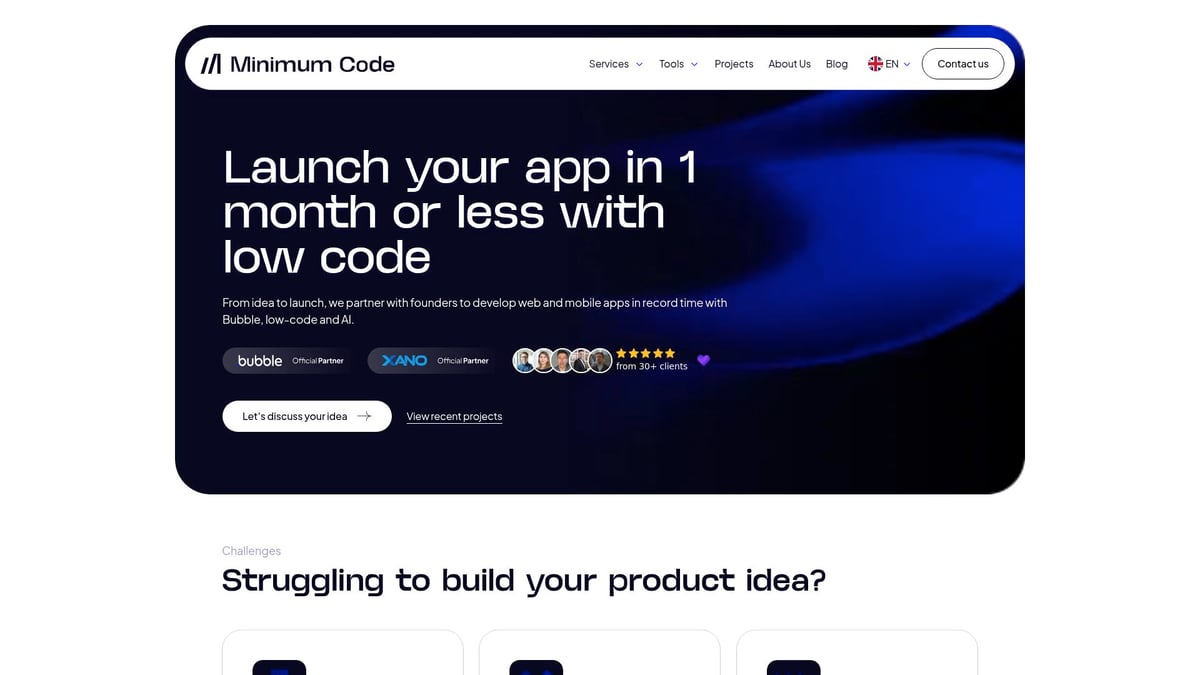
Agencies like Minimum Code offer a full-service approach, covering everything from discovery to post-launch support. They also prioritise GDPR compliance and scalable hosting, which is essential for EU founders. Real-world examples show startups launching MVPs in under a month, allowing for fast market validation and iteration.
Bubble.io is ideal for those who want to control costs and timelines without sacrificing quality.
Custom code development: when is it necessary?
Custom code is often required when your project needs advanced integrations, unique features, or high scalability. While the cost of website development 2026 is higher for custom builds, the investment is justified for SaaS platforms or products with complex backend logic.
Custom development offers full control over architecture and security, but comes with longer timelines and higher maintenance costs. It is best suited for founders with clear product-market fit and the need to differentiate on technology.
Consider custom code only if off-the-shelf or no-code solutions cannot meet your requirements.
Evaluating partners and portfolios
Choosing the right partner is just as important as selecting the development approach. Review agency or freelancer portfolios, focusing on experience with similar projects and tech stacks. Ask about post-launch support, security, and compliance expertise, especially if operating in Europe where regulations impact the cost of website development 2026.
Use a checklist to compare potential partners:
- Relevant project experience
- Transparent pricing and timelines
- Support and maintenance options
- Compliance and data protection knowledge
Interview multiple candidates and check references before making your decision.
You've just explored the key factors shaping website development costs in 2026, from choosing the right tech stack like Bubble io to understanding where your budget really goes. Navigating these decisions can feel overwhelming, especially with evolving tools and compliance standards. If you're ready to plan your project with clarity and confidence, we can help you break down your ideas, identify essential features, and set a realistic budget—without any hidden surprises. Let's talk about how you can get your website or app off the ground quickly and securely. Book a free discovery call
.avif)


Explore related articles


Ready to build your product?