
Top 6 MVP Development Agencies in 2026: Costs, Red Flags & How to Choose
.png)

Thinking about the most valuable player?
Choosing an MVP development agency is one of the highest-stakes decisions a startup makes early on. But it has nothing to do with sports, unless you pick the wrong one and you'll spend €50,000 and six months getting something that doesn't work, doesn't scale, and doesn't reflect what your users actually need. Then your ability to juggle and jump sharpens.
Pick the right agency and you'll have a production-ready product in the hands of real users in four to eight weeks, with the budget left to actually grow it.
This guide from Minimum Code covers everything you need to make that decision well: what MVP software development agencies actually do, the difference between traditional and no-code agencies, what to look for, what red flags to avoid, how much it costs, and which agencies are worth considering in 2026.
What is an MVP software development agency?
An MVP (Minimum Viable Product) software development agency specialises in building the first functional version of a digital product, one that contains only the core features needed to validate an idea with real users.
The emphasis is on working product, not just prototype. An MVP is a functional application that real users can sign up for, interact with, and pay for. It's stripped down to the essentials, but it works end-to-end.
What a good MVP agency does:
- Helps you define and scope your product clearly before building starts
- Maps user journeys, data models, and technical architecture
- Designs a UI/UX that's usable from day one
- Builds the core product in focused sprints
- Tests and iterates based on real feedback
- Launches and supports you through the critical early-adoption phase
What a good MVP agency does not do: build everything on your wish list, pad timelines unnecessarily, or hand you a product and disappear.
Traditional vs. no-code MVP agencies: what's the difference and why it matters
This is the most important distinction to understand before you start talking to agencies, because it shapes everything, timeline, cost, team size, flexibility, and what happens after launch.
Traditional MVP agencies build using custom code, React, Node.js, Python, Ruby on Rails, and similar stacks. Everything is written from scratch. You get complete code ownership and theoretically unlimited flexibility, but at a significant cost: traditional MVP development typically takes four to six months and costs €80,000 to €200,000+. You'll also need a technical team to maintain and iterate on what was built.
No-code MVP agencies build using visual development platforms, primarily Bubble.io, with tools like Xano for backend, Figma for design, and FlutterFlow for mobile. The entire frontend, backend, database, and workflow logic is assembled visually rather than written as code. This approach delivers a comparable product in four to eight weeks at €8,000 to €30,000, and a single experienced developer can maintain it post-launch.
The trade-off: no-code platforms don't export code, which means a degree of vendor dependency. But for the vast majority of MVPs, SaaS tools, marketplaces, client portals, B2B platforms, this is a trade-off that strongly favours no-code. You launch faster, spend less, and learn more before committing to any architectural decisions.
What to look for in an MVP software development agency
Genuine discovery process
The single biggest differentiator between agencies that deliver and agencies that don't is what happens before development starts. A good agency invests serious time in understanding your product, your users, and your goals, before writing a single workflow or designing a single screen. They'll map your user journeys, define your data model, identify your integrations, and challenge assumptions that might lead you to build the wrong thing.
If an agency is eager to start building immediately without a thorough discovery phase, treat that as a warning sign.
Portfolio of real, launched products
Ask to see apps they've built that are live and in use, not just mockups or case study screenshots. Look at the complexity of what they've shipped: does it reflect the kind of product you're building? Minimum Code's project portfolio includes named, live platforms across marketplaces, SaaS, and B2B tools, each one demonstrable and verifiable.
Honest scoping and fixed timelines
A reliable agency will give you a clear scope estimate with a realistic timeline after discovery. Be wary of agencies that can't give you a meaningful estimate until they've "started the work," or that consistently discover new scope mid-project. Good MVP agencies have done this enough times to know what four weeks of building looks like.
Communication rhythm and transparency
You should know exactly where your project stands at all times. Weekly sprint reviews, shared project management tools, and direct access to the team building your product are table stakes. Agencies that communicate only through account managers or send monthly update emails are a red flag.
Post-launch support and thinking beyond the MVP
An MVP is not a final product, it's a starting point. The right agency thinks about what happens after launch: how you'll iterate based on feedback, how the app will scale as you grow, and what the maintenance model looks like. Ask specifically about post-launch engagement before you sign anything.
GDPR and compliance awareness (critical for European startups)
If you're building for a European market, your MVP needs to be GDPR-compliant from day one, not retrofitted after launch. Ask your agency explicitly about data hosting regions, privacy rule configurations, and data protection practices. Minimum Code builds every EU project with Frankfurt-hosted Bubble infrastructure and GDPR compliance as a standard requirement, not an optional add-on.
Red flags to watch for
Agencies that can't show live apps. If their portfolio is all mockups and "coming soon" screens, they haven't shipped real products. Don't be the first.
Vague timelines and estimates. "It depends" is acceptable early in a conversation. It is not acceptable in a signed proposal.
No discovery phase. Jumping straight to wireframes or development without understanding your users and data model produces the wrong product, faster.
Overpromising on features. If an agency agrees to everything on your feature list without pushing back, they either don't understand what they're committing to or they're planning to charge for changes later.
Large offshore teams for small MVPs. A 50-person team billing by the hour on a 4-week MVP is a billing model, not a product model. Good MVP agencies keep teams lean and accountable.
No post-launch plan. An agency that delivers and disappears leaves you with a product you can't maintain or iterate on.
The top 6 MVP software development agencies in 2026
1. Minimum Code - Best for no-code MVPs in Europe (UK, Germany, Austria)

Minimum Code is a specialist no-code agency based across Germany, Austria, and the UK, focused exclusively on building production-grade web apps using Bubble.io. Founded by Tom Louwagie, the team has shipped real products across B2B SaaS, marketplaces, content platforms, and internal tools, all verifiable in their project portfolio.
What distinguishes Minimum Code is a genuine product-first approach: every project starts with a structured discovery process that defines scope, data architecture, user journeys, and compliance requirements before development begins. This is the foundation that makes four-to-eight-week delivery reliable rather than aspirational.
Best for: Non-technical founders building B2B SaaS, marketplaces, or client-facing platforms in Europe. Particularly strong for GDPR-compliant builds and EU-hosted infrastructure.
Tech stack: Bubble.io
Typical timeline: 4–8 weeks
Starting from: €8,000
Based in: Germany, Austria, United Kingdom
2. Airdev - Best-known Bubble agency globally

Airdev is one of the original and most established Bubble development agencies, having built hundreds of apps on the platform since Bubble's early days. They offer end-to-end Bubble development including their own Canvas framework for faster builds, and have a large team of certified Bubble developers.
Best for: Founders who want a high-volume, established Bubble agency with a large team and extensive documentation.
Limitations: US-based with higher pricing than European agencies; less suited to EU compliance-first projects.
3. LowCode Agency - Best for no-code MVPs in the US market
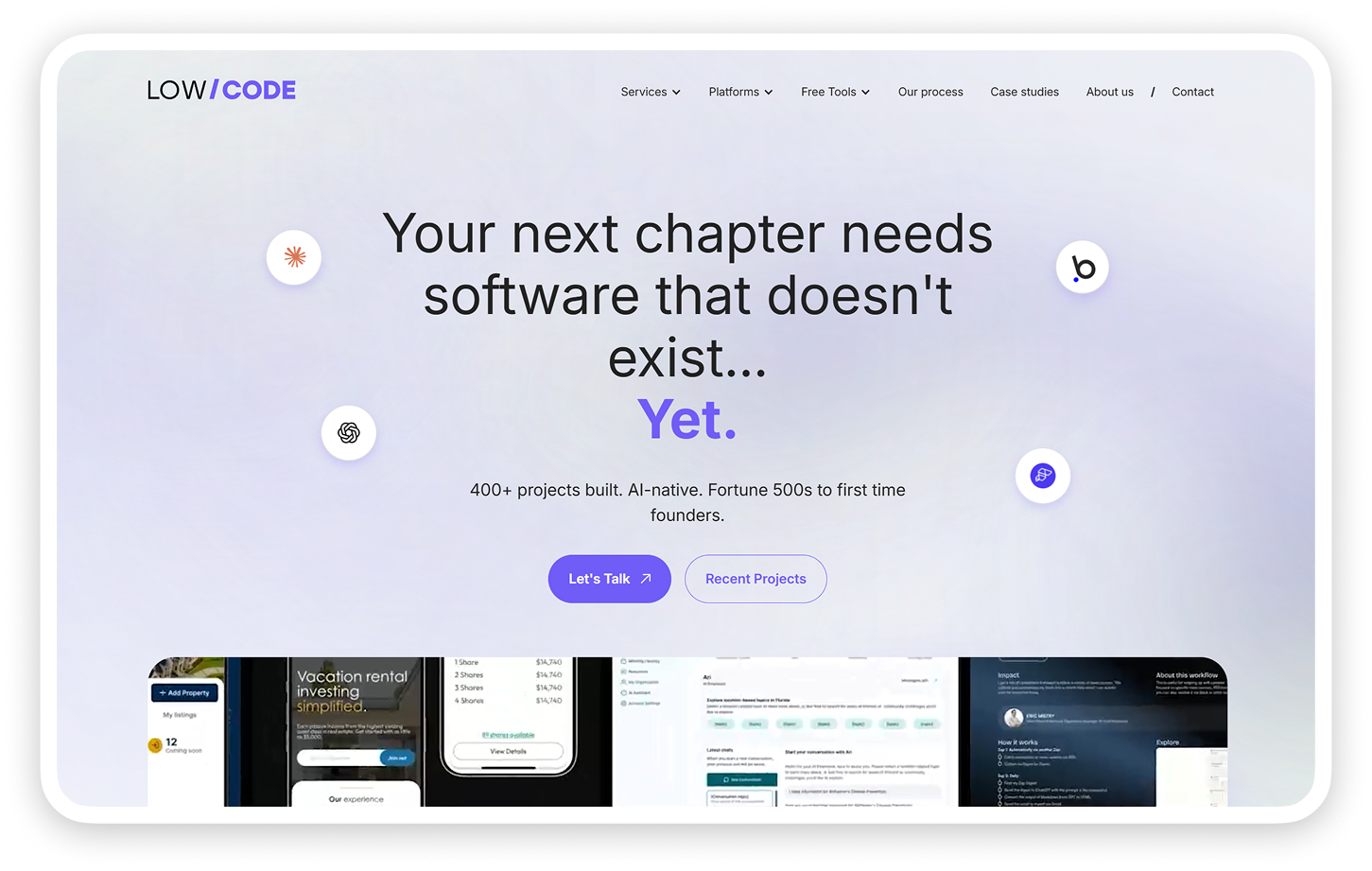
LowCode Agency (Miami) is a high-volume no-code agency specialising in Bubble, FlutterFlow, Glide, and Webflow. With 330+ apps built and a focus on speed, they've delivered MVPs for well-known brands and have strong case studies with verifiable metrics.
Best for: US-based startups wanting fast no-code delivery across multiple platforms including mobile.
Limitations: US-centric; less focus on EU GDPR compliance and European market context.
4. Softr Studio - Best for simple data-driven tools quickly

Softr is a no-code platform and agency partner network that builds web apps from Airtable and Google Sheets. For very simple internal tools, directories, and portals, it's fast and affordable.
Best for: Internal tools, directories, client portals backed by existing spreadsheet data.
Limitations: Not suitable for complex logic, multi-user platforms, or production-grade SaaS.
5. Netguru - Best for traditionally coded MVPs with strong UX

Netguru is a well-established Polish product development agency offering traditional development services with a strong emphasis on product thinking and UX. They've worked with funded startups and scale-ups across Europe.
Best for: Funded startups with complex technical requirements that genuinely can't be served by no-code platforms.
Limitations: Traditional coding timelines (3–6 months) and budgets (€80,000+). Not the right choice for early-stage validation.
6. Ideamotive - Best for matching with vetted freelance developers
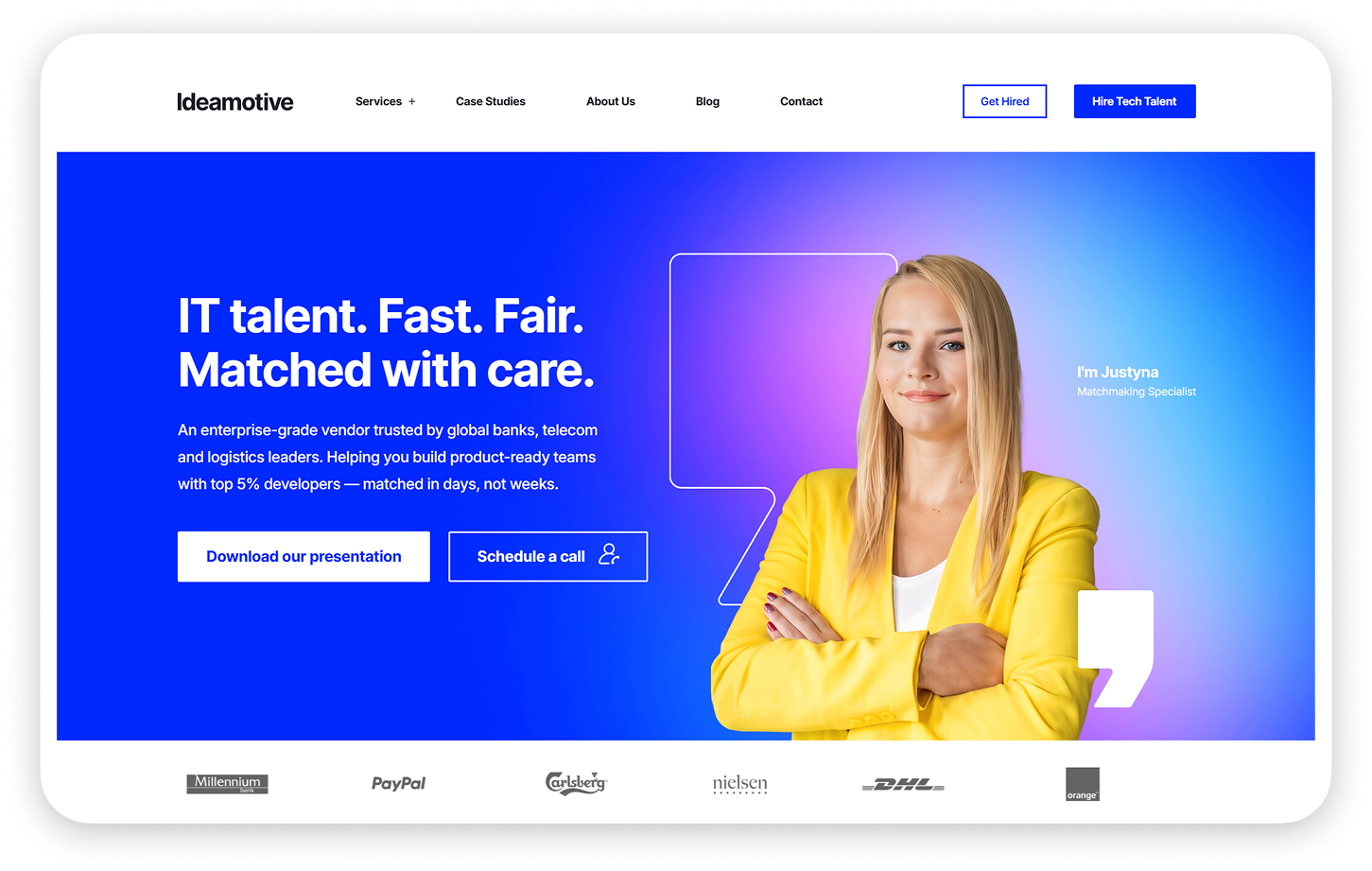
Ideamotive connects startups with vetted freelance developers and product teams rather than building in-house. Useful for founders who want to hire a development team rather than engage an agency.
Best for: Startups that want to build an extended team rather than outsource to an agency.
Limitations: Coordination overhead of managing freelancers; variable quality depending on matching.
How much does an MVP software development agency cost?
Cost varies significantly based on approach, team location, and product complexity.
Beyond the build cost, factor in:
- Platform hosting: Bubble from $29/month (annual billing), scaling with usage
- Third-party integrations: Stripe, email services, analytics tools, typically €50–€200/month depending on stack
- Ongoing maintenance: One experienced no-code developer can maintain most Bubble apps; traditional apps require larger teams
- Post-launch iteration: Budget for at least two to three post-launch sprints before your product stabilises
The total cost of a no-code MVP over 12 months, including build, hosting, integrations, and iteration, is typically €20,000–€50,000. The equivalent traditional build over the same period is often €200,000+.
What to ask before committing
Don’t think these are interview questions, they're more like filters. The answers will tell you quickly whether an agency is worth engaging further, which gives better insight and value and makes you feel more at ease.
Can you show me three live apps you've built that are similar in complexity to mine?
You want URLs, not screenshots. If they can't show live work, move on.
What does your discovery process look like before development starts?
A good agency will describe a structured process. A bad one will say "we'll start with wireframes."
Who specifically will be working on my project, and how many projects are they running simultaneously?
You want named people and reasonable workloads. Anonymous offshore teams with 10 simultaneous projects are a risk.
What happens if we discover a new scope mid-project?
Good agencies have a clear change management process. Bad ones say "we'll figure it out."
How do you handle GDPR compliance for European users?
If they look blank, move on. If they explain EU hosting regions, data type privacy rules, and data handling practices, that's a team that knows what they're doing.
What does post-launch engagement look like?
Maintenance model, iteration support, and handover documentation. Non-negotiable.
What's the realistic timeline from signed contract to live product?
Pin them down. "It depends" after a detailed scope conversation is not acceptable.
The Minimum Code approach to MVP development
Minimum Code's development process is structured around four phases that consistently deliver production-ready products in four to eight weeks:
Discovery: Scope definition, user journey mapping, data architecture, integration planning, and compliance requirements. This phase is what makes everything downstream reliable.
Design: UI/UX in Figma, covering all core user flows, responsive layouts, and a design system that makes the Bubble build faster and more consistent. Led by Minimum Code's design team.
Development: Sprint-based Bubble development starting with the core happy path, then secondary flows, integrations, and edge cases. Weekly progress reviews and direct access to the build team.
Launch and beyond: Deployment, testing, GDPR configuration, and post-launch support. Minimum Code stays engaged after launch for iteration, maintenance, and scaling, not just delivery.
For existing Bubble apps that have grown organically and need a structural health check, the app audit service identifies performance issues, security gaps, and architectural problems before they affect users.
FAQs - Frequently asked questions
What's the difference between an MVP agency and a software development agency?
A software development agency builds whatever you specify. An MVP agency helps you figure out what to build, scopes it to the minimum that validates your idea, and delivers it fast. The strategic input is the differentiator, a good MVP agency will push back on features that don't belong in version one.
Is a no-code MVP as good as a traditionally coded one?
For most product categories, yes. Bubble-powered apps have raised millions in funding and serve tens of thousands of users. The constraints are real but rarely relevant at the MVP stage. By the time you reach the scale where no-code becomes limiting, you'll have the traction and capital to make better-informed architectural decisions.
How do I know if an agency is genuinely good at Bubble?
Ask to see live apps. Ask about their approach to data modelling and workflow optimisation. Ask how they handle performance at scale. Agencies that can answer these questions specifically, not generically, have done the work.
Can I maintain the app myself after an agency builds it?
Bubble apps are maintainable by non-developers for simple updates. For anything involving new workflows, integrations, or structural changes, you'll need a Bubble developer. The good news is that maintenance of a well-built Bubble app typically requires one experienced developer rather than a team, a significant ongoing cost advantage over traditionally coded products.
What's the fastest an agency can realistically deliver an MVP?
A very tightly scoped, simple product with a clear brief and fast decision-making on the client side can be live in two to three weeks. A typical SaaS or marketplace MVP is four to six weeks. Anything involving complex multi-user logic, multiple integrations, or novel product architecture takes longer. Be sceptical of agencies that quote one week for anything with real complexity.
How do I avoid scope creep with an MVP agency?
Lock your scope in discovery, get it in writing, and treat every new feature request as a post-launch conversation. A good agency will enforce this boundary for you, it's in both your interests to launch on time with a focused product rather than delay for features that may turn out to be irrelevant.
Get ready to knock it out of the park
The most valuable MVP Ready to build? Book a free discovery call with Tom to discuss your MVP idea and get a realistic scope, timeline, and cost estimate, no commitment required.
.avif)


Explore related articles

Ready to build your product?