
No-Code vs Low-Code vs Full-Code: 2026 Guide
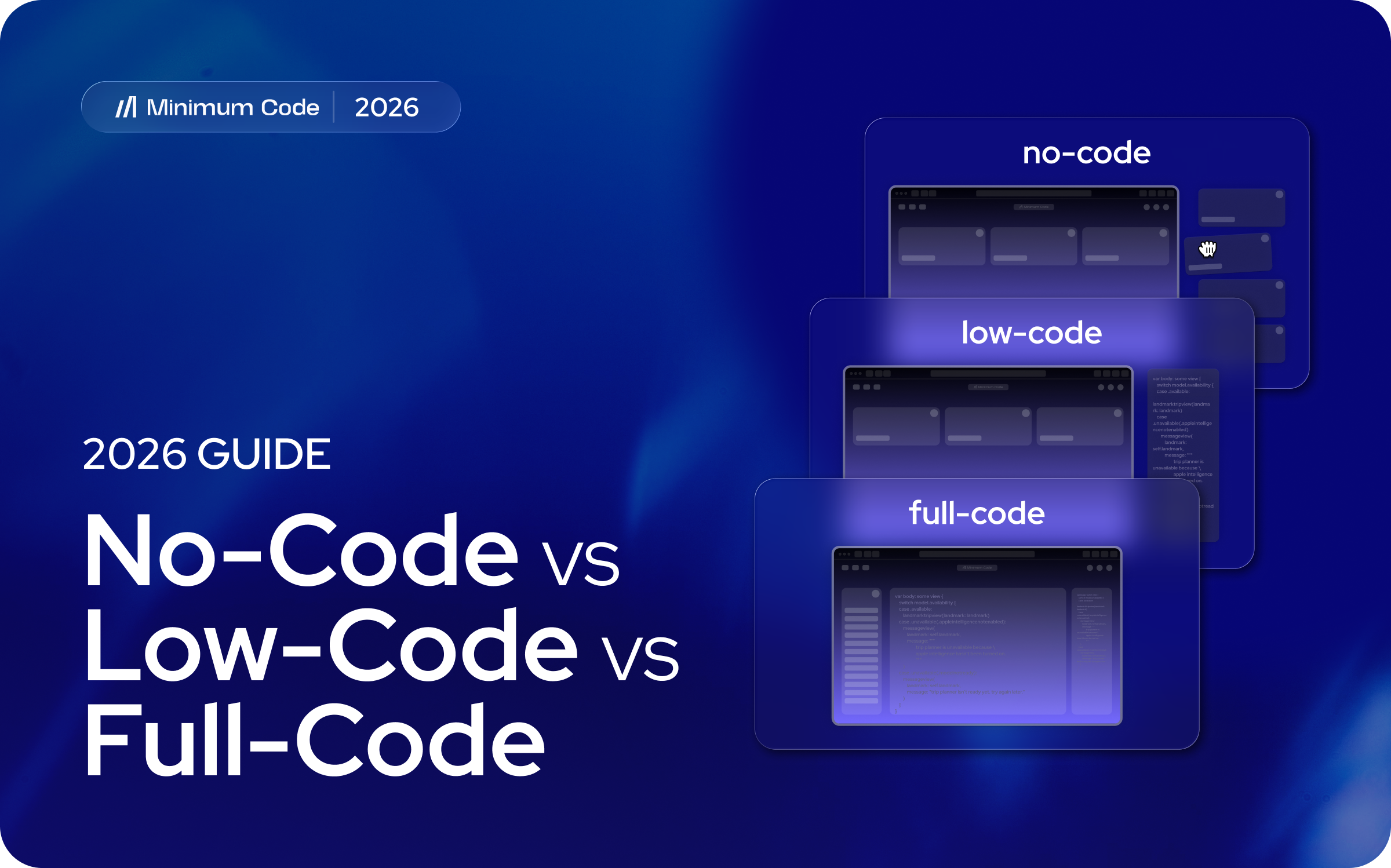

The way software gets built has changed dramatically over the last few years. What used to require a team of engineers, months of development, and a significant budget can now often be done in weeks, sometimes by people with no technical background at all. But that shift has also created a lot of confusion around terminology. No-code, low-code, full-code: what do these actually mean, when does each approach make sense, and how do you choose the right one for your project?
Choosing the wrong approach costs more than money. Committing to full-code when no-code would suffice means months of delayed validation, while choosing no-code without understanding its architectural limits creates costly rebuilds later. Companies that hire Bubble developers experienced across all three approaches get honest guidance on which path actually fits their specific product requirements, timeline constraints, and growth plans.
This guide cuts through the noise and gives you a clear, honest comparison of all three, so you can make a decision based on your actual situation, not buzzwords.
What each approach actually means
No-code development means building software entirely through visual interfaces, drag-and-drop editors, pre-built components, and configuration panels, without writing any code. Platforms like Bubble.io, Glide, and Adalo fall into this category. The entire build process happens visually, which makes it accessible to founders, product managers, and anyone with a logical mindset, regardless of technical background.
Low-code development sits between no-code and traditional development. It uses visual tools to handle the routine parts of building, UI layouts, standard workflows, database connections, but allows or requires developers to write custom code for specific functionality. Platforms like OutSystems, Microsoft Power Apps, and Retool are low-code. Bubble.io itself has low-code characteristics too, since it lets developers extend apps with custom JavaScript and server-side code when needed.
Full-code (or traditional) development means building from scratch using programming languages, JavaScript, Python, React, Node.js, and so on. Everything is custom-built: the frontend, the backend, the database logic, the API integrations, the infrastructure. It offers maximum flexibility and control, but also requires the most time, cost, and technical expertise.
The lines between these categories have blurred significantly in 2026, particularly as no-code platforms like Bubble have become sophisticated enough to power real production applications used by thousands of users.
Speed and time to market
This is where no-code and low-code have the clearest advantage. A well-scoped MVP built on Bubble.io with an experienced team like Minimum Code can go from discovery to launch in four to eight weeks. The same product built with traditional development typically takes four to six months minimum, often longer.
The reason is compounding efficiency. In no-code, you're not writing boilerplate code for user authentication, database CRUD operations, form validation, or API connections. Those are handled visually, which eliminates entire categories of development work. You spend your time on product logic and user experience rather than infrastructure.
Low-code is faster than full-code but slower than no-code. The custom code components still require development cycles, testing, and debugging. The visual layers accelerate the routine work, but the moment you need something bespoke, you're back in the speed profile of traditional development.
Full-code is the slowest approach for initial builds. Every feature, every integration, every workflow has to be written, tested, and deployed. For an early-stage product that still needs to validate its core assumptions, that's a significant risk.
Cost
There are also ongoing cost differences. A Bubble.io app can often be maintained by one experienced developer rather than an entire engineering team. That's a structural cost advantage that compounds over time, particularly for startups that need to stay lean through early growth phases.
The important caveat: no-code platforms have their own costs. Bubble hosting starts from around €25 per month and scales with usage. Third-party integrations, payment processors, email platforms, analytics tools, add to your monthly overhead. These are real costs, but they pale against the alternative.
Flexibility and customization
This is where full-code wins, and where it's worth being honest about the trade-offs.
Full-code gives you complete control over every aspect of your product. You can build anything, proprietary algorithms, complex real-time systems, deeply custom UI components, specialized infrastructure. There are no platform constraints, no vendor lock-in, and no ceiling on what you can build.
No-code has constraints. You're working within the boundaries of what your platform supports, and those boundaries do exist. For Bubble specifically, the areas where you may hit limits include highly custom UI animations, very high-throughput real-time features, and some edge cases in data processing. For most MVPs, SaaS platforms, marketplaces, and internal tools, these constraints are rarely a problem. But for certain products, particularly those with genuinely novel technical requirements, they can be.
Low-code is more flexible than no-code because you can write custom code where needed. But that flexibility comes at the cost of speed and budget, and it introduces complexity that pure no-code avoids.
The nuance that often gets missed: Bubble itself supports custom JavaScript plugins and server-side actions, which means the line between no-code and low-code is fuzzy in practice. An experienced Bubble agency can extend a Bubble app significantly beyond its out-of-the-box capabilities when specific functionality requires it.
Scalability
A common concern about no-code is whether it can scale. In 2026, for most startup use cases, the answer is yes, but with nuance.
Bubble runs on AWS infrastructure, which means horizontal scalability is built in at the hosting level. The platform has powered apps with tens of thousands of users without hitting infrastructure limits. The bottlenecks, when they arise, are usually at the application level, poorly structured databases, inefficient queries, workflows that run more operations than necessary. These are solvable problems, but they require experience to avoid and expertise to fix. This is exactly why a no-code app audit is one of the most valuable investments a growing Bubble app can make.
Full-code scales best at extreme volumes and with highly specialized infrastructure requirements, think platforms processing millions of transactions per day or requiring custom load balancing. For the vast majority of startups, they'll never reach a scale where no-code becomes the limiting factor before they've raised enough to rebuild with a larger engineering team if needed.
Low-code occupies an interesting middle ground: more scalable than no-code in theory, but in practice, scaling low-code platforms often hits the same organizational limitations as full-code, you still need experienced developers to architect and maintain a system that grows.
Team requirements
Full-code requires engineers. Senior ones, ideally, with experience in your specific tech stack, security best practices, and production deployment. Hiring and retaining engineering talent is expensive, time-consuming, and increasingly competitive, particularly in European tech hubs like Berlin, Munich, and London where Minimum Code operates.
Low-code still requires developers, though typically fewer of them. A low-code project might need one senior developer where full-code needs four, but that developer still needs to be skilled in both the platform and the underlying programming paradigms.
No-code is the only approach where non-technical founders can meaningfully participate in the build, not just reviewing, but actually making product decisions and sometimes implementing them. At Minimum Code, the product discovery process is designed to work with founders at exactly this level: understanding your requirements deeply, then translating them into a no-code architecture that doesn't require you to speak developer.
When to choose each approach
Choose no-code when:
- You're building an MVP or early-stage product and need to validate quickly
- Budget is constrained and time to market matters
- You don't have a technical co-founder or in-house engineering team
- Your product fits within established categories, SaaS platforms, marketplaces, internal tools, client portals, community apps
- You want to stay lean post-launch and avoid large engineering overhead
Choose low-code when:
- You have developers on your team who need to move faster than full-code allows
- Your product has standard components that visual tools handle well, plus specific bespoke requirements that need custom code
- You're working within an enterprise environment where specific platforms are already established
Choose full-code when:
- Your product has genuinely novel technical requirements that no visual platform can support
- You're building in a domain with strict infrastructure requirements, certain fintech, medtech, or defense applications
- You've already validated your product and are rebuilding for extreme scale
- You have a strong in-house engineering team and the budget to sustain it
The honest truth is that most early-stage products are not technically novel enough to require full-code from the start. The risk isn't building on no-code, it's spending six months and €100,000+ on a full-code product before knowing whether users actually want it.
The hybrid reality of 2026
The clean lines between these three categories have blurred significantly. Bubble supports custom code extensions. AI tools like Claude Code can generate and integrate custom components into no-code apps. Sophisticated no-code architectures combine Bubble frontends with purpose-built backends where needed. The question is no longer really "which category?" but "what's the right balance of visual tooling and custom code for this specific product?"
Minimum Code's approach reflects this: primarily no-code and low-code using Bubble.io, extended where necessary with custom integrations and backend logic. The goal is always the fastest path to a real, working product that can grow, not the most technically pure one. You can see that in practice across the project portfolio, which covers everything from B2B marketplace platforms to mobile apps and SaaS tools.
FAQs - Frequently asked questions
Can a no-code app really compete with a custom-coded product?
For most product categories, yes. Bubble-powered apps have raised millions in funding and serve large user bases. The platform constraints that exist rarely affect early-stage product viability, and by the time they might, most teams have the resources to make different architectural choices if needed.
What happens if my no-code app outgrows its platform?
This is a real consideration and worth planning for. The practical answer: most products never reach this point before they've validated their model and raised capital. If and when it becomes relevant, the product knowledge, user base, and revenue you've built on no-code makes rebuilding much lower risk than starting cold.
Is low-code just no-code with some coding?
Broadly yes, though the distinction matters in practice. Low-code platforms tend to be designed with developers in mind, offering more technical depth and custom code capability from the start. No-code platforms prioritize accessibility. The line is genuinely blurry and both categories are moving closer together as platforms evolve.
How long does it take to learn no-code development?
Enough to build simple apps: a few weeks. Enough to build complex, production-grade apps: several months of focused practice. Bubble in particular has a steeper learning curve than simpler no-code tools, which is one reason working with an experienced Bubble developer or agency is often faster than learning yourself.
Does full-code always produce a better product?
Not inherently. A product is good because of its design, its product-market fit, and how well it solves a real problem, not because of its tech stack. Many full-code products have poor UX and performance issues. Many no-code products are fast, reliable, and well-designed. The stack is a means to an end.
What's the best approach for a startup with no technical co-founder?
No-code is almost always the right starting point. It lets you build, test, and iterate without the dependency on engineering talent you don't have yet. If the product proves itself, you'll have the traction and capital to make more significant technical investments from a position of strength.
The secret code
If you're trying to figure out which approach is right for your specific product, book a free discovery call with Tom. You'll get a straight answer and a realistic scope estimate, no commitment required.
.avif)


Explore related articles

Ready to build your product?