
How to Migrate from Bubble.io to Next.js | The 2026 Guide
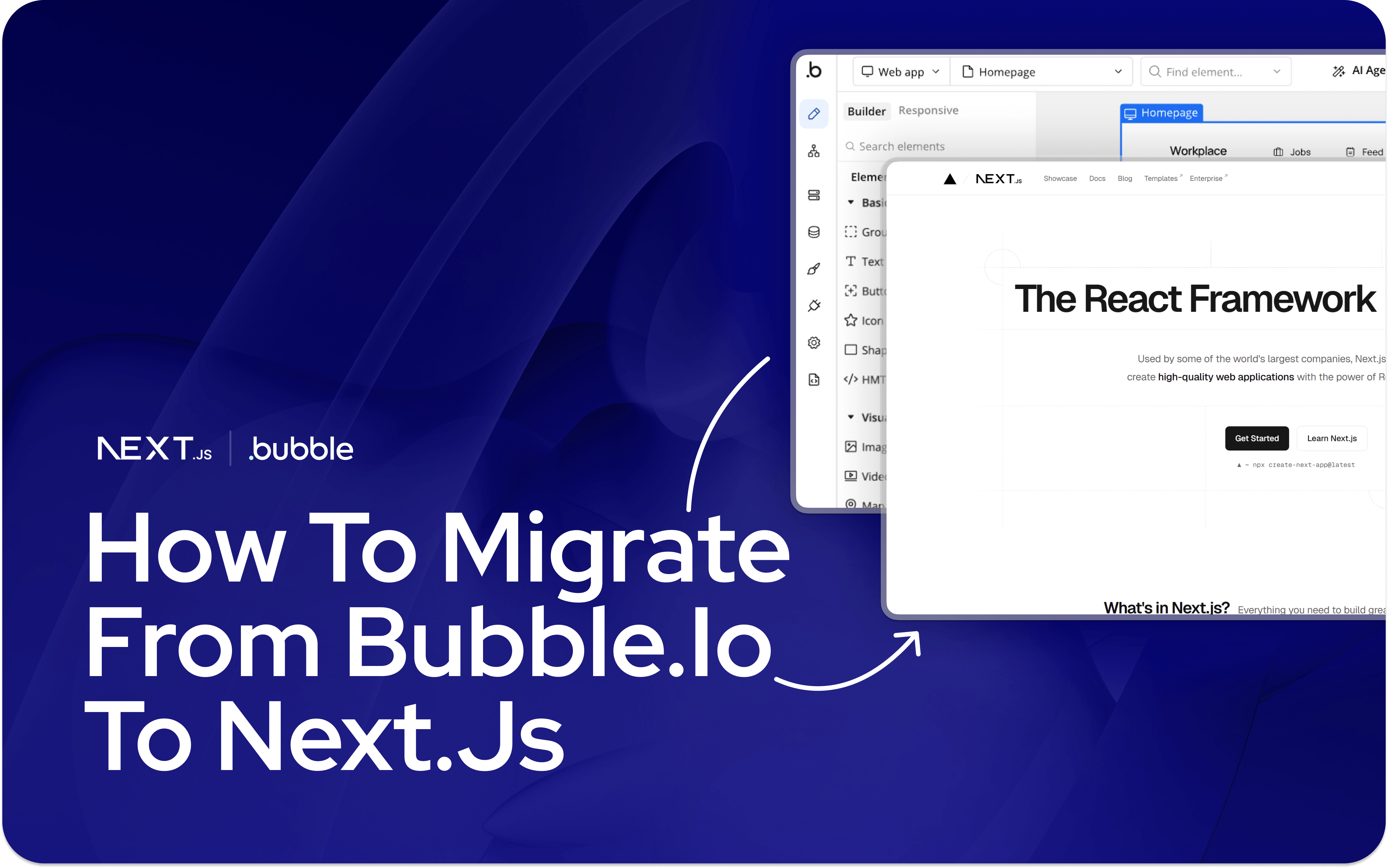

Migrate from Bubble.io to Next.js: The 2026 guide to transition
AI-assisted coding has fundamentally changed the math on leaving Bubble. In 2026, tools like Claude Code have lowered the cost of custom development to a point where founders who once felt locked in are now actively planning their exits.
But here is what most migration guides won't tell you, but Minimum Code does: the majority of Bubble apps that feel broken aren't broken because of Bubble. They are struggling because of bad architecture, inexperienced developers, or poor product planning. Migrating a badly architected app just moves the mess to a new stack. This guide helps you determine whether you actually need to migrate and, if you do, how to execute the transition properly.
Before assuming you've outgrown the platform, consider whether working with professionals who hire Bubble developers with proven architecture expertise could solve your performance issues without the risks and costs of a complete rebuild.
Before you migrate: Is Bubble really the problem?
Most Bubble is slow or Bubble is limited complaints trace back to root causes that have nothing to do with the platform itself:
- Bad Data Architecture: Fetching thousands of records into the browser instead of using server-side filtering.
- Over-reliance on Plugins: Using dozens of third-party plugins for features that should be native, creating DOM weight.
- Unoptimized Workflows: Failing to account for Workload Unit (WU) efficiency, leading to massive bills and slow processing.
If you worked with an inexperienced developer, the answer might be a better Bubble developer—not a total migration. Fix the root cause first. Rebuilding a poorly designed database in Postgres won't make it faster; it will just make it harder to change.
When migration genuinely makes sense
Migration is the right move when you hit hard ceilings that no amount of optimization can solve:
- Performance Limits: You require high-concurrency data processing or sub-100ms response times that a shared-tenant engine cannot provide.
- SEO Constraints: Your growth depends on Server-Side Rendering (SSR) and edge-delivery that requires a framework like Next.js.
- Engineering Talent: You need to hire senior engineers who require standard CI/CD pipelines, Git-based workflows, and a code-first environment.
- Vendor Lock-in: You are preparing for a Series A or an acquisition where the IP safety of a self-hosted codebase is a prerequisite.
- Custom Integrations: You need to integrate proprietary SDKs or low-level hardware libraries that Bubble’s API connector cannot bridge.
Why founders are leaving Bubble in 2026
The trigger for migration has changed because the alternatives have become radically easier to manage:
- AI Accessibility: Claude Code can not yet analyze internal Bubble logic, but as Bubble agency we know how to quickly gather pages, workflows, data, options sets data and feed this to Claude Code to then start the migration process, this reducing the rebuild time significantly.
- Plunging Development Costs: AI handles the boilerplate (Auth, CSS, CRUD), allowing developers to focus strictly on complex business logic.
- Modern DX: The combination of Next.js and Supabase offers a Developer Experience (DX) that rivals no-code for speed, while offering infinite flexibility.
The target stack: Next.js + Supabase + Vercel
If you decide to leave, this is the architecture that replaces Bubble’s all-in-one ecosystem:
- Next.js (Frontend + API): Replaces the Bubble Editor. It handles your UI, routing, and server-side logic.
- Supabase (Database + Auth): Replaces the Bubble Database and User tab. It provides a professional Postgres database, secure authentication, and file storage.
- Vercel (Hosting + CI/CD): Replaces Bubble’s hosting. It provides automated deployments and global edge-scaling.
Step 1: Audit your Bubble app
Do not write code until you have documented your current Source of Truth:
- Data Schema: Map every data type and relationship (one-to-many, many-to-many).
- Workflow Logic: Document every backend trigger and recursive workflow.
- Third-Party Connections: List every API call, header requirement, and webhook.
- Privacy Rules: These must be translated into Row Level Security (RLS) in Supabase.
Step 2: Data migration
Exporting data from Bubble is notoriously difficult.
- Restructuring: Bubble often uses hidden arrays for relations. You must restructure these into proper Postgres Join Tables.
- Preserving Users: You can export emails and IDs, but passwords cannot be exported. You will need a Bridge strategy (see below) to ensure a smooth user transition.
Step 3: Rebuilding the frontend with Claude Code
We use Claude Code to accelerate the UI rebuild, but we use the Bubble app as a visual reference, not a blueprint.
- Component Logic: Feed Claude the structure of your Bubble pages.
- Tailwind Generation: Claude can generate responsive, accessible React components using Tailwind CSS that mimic your Bubble design with precision.
- Logic Extraction: Use AI to interpret complex Bubble expressions and convert them into clean TypeScript functions.
Step 4: Recreating backend logic
Bubble's visual workflows must be converted into API Routes or Supabase Edge Functions.
- Automations: Recursive workflows are replaced by pg_cron in the database or scheduled Cron jobs in Vercel.
- Integrations: Convert Bubble API Connector calls into secure, typed fetch requests in your Next.js backend.
Step 5: Testing and parallel run
Run the new Next.js app on a subdomain and perform Shadow Testing:
- Data Parity: Ensure that data saved in the new system matches the old system’s logic.
- User Acceptance (UAT): Have power users test the new speed and interface before the final cutover.
The hard parts most guides skip
- Auth Migration: To avoid forcing password resets, use a Magic Link or Temporary Token system for the user’s first login on the new platform.
- File Migration: You must script the transfer of all images/files from Bubble’s S3 storage to Supabase Storage and update thousands of URLs.
- SEO Redirects: You must map every Bubble URL to its new Next.js equivalent to maintain your search rankings.
DIY vs. Agency: When to get help
DIY: A technical founder can handle a simple internal tool or a basic CRUD app using Claude Code solo. Expect to spend 150+ hours.
Agency: If you have active users, complex database relationships, or high-stakes financial data, you need experts. A mistake in Database Schema or Security Policies during a migration can be fatal for a scaling startup.
At Minimum Code, we have built over 300 Bubble apps. We aren't just a code shop; we are platform experts who know exactly what is worth preserving from your Bubble build and what needs to be redesigned for a code-first environment.
Conclusion
Migrating from Bubble.io to Next.js + Supabase is now a realistic path—but it is not always the right move. If your app is struggling because of bad architecture, a migration will simply move the problem to a new home.
Start by diagnosing the root cause. If the answer really is a platform ceiling, then migration with a partner who knows exactly how to preserve your data and logic is the fastest path to your product's next phase.
Not sure if you need to migrate or just need better Bubble architecture? Book a free call with Tom, founder of Minimum Code → Contact him here to start your project
.avif)


Nieuwste artikelen


Klaar om je product te bouwen?