
How to migrate from Bubble without losing momentum
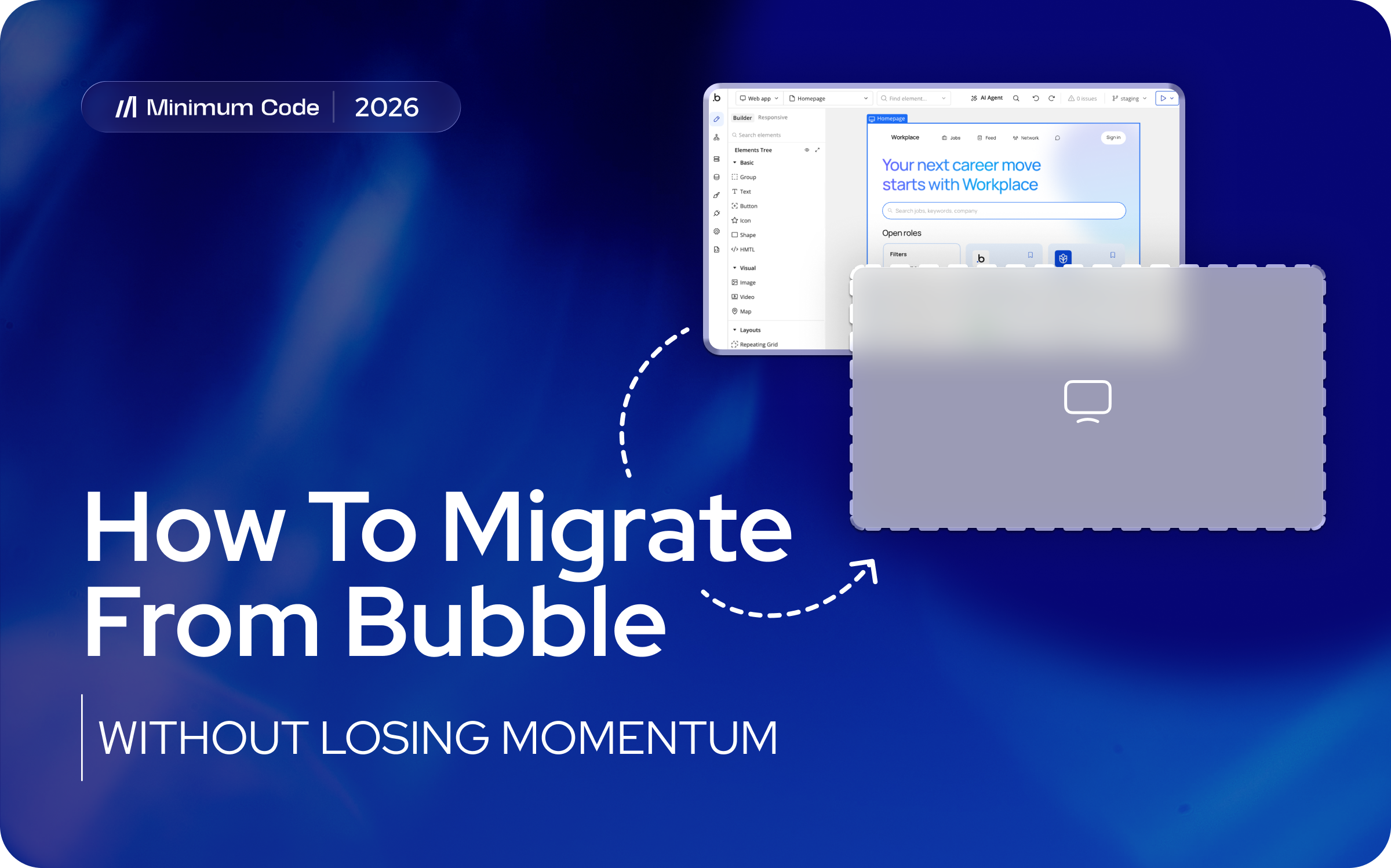

So you've finally hit the wall, and you’re wondering how to migrate from Bubble.
Maybe it's the performance. Maybe it's the pricing. Maybe you just need to do something Bubble physically cannot do, and you're tired of hearing "that's not really possible in a no-code platform."
Whatever it is, you're here because you need to migrate, and you're scared it's going to be a nightmare.
It probably will be. But not for the reasons you think.
I'm going to be honest with you: migrating from Bubble is going to suck more than you think. It'll take longer, cost more, and you'll question your life choices around week six. But staying on a platform that can't support where you're trying to go? That sucks worse. Here's what matters when you're planning this thing.
Why you're really leaving Bubble (and why that matters)
Before you start planning this migration, figure out why you dislike Bubble right now. And I mean the real reason, not the one you told your co-founder.
Because here's the truth: if you're leaving because of performance issues, but you migrate to another no-code platform with the same architecture, you've just wasted six months and a bunch of money recreating the same problem.
Your specific pain point determines everything else.
We worked with a client (customer onboarding platform, about 30k users) who was convinced Bubble was the problem. Load times were hitting 8-10 seconds whenever they processed batch imports. Which happened multiple times a day. Brutal user experience.
They were ready to migrate to Rails. Had the budget. Had a developer lined up.
We made them dig into the actual workflows first. Turned out 90% of the problem was one workflow making 50+ sequential database calls. Not Bubble's fault. Just badly structured logic.
They fixed it in Bubble. Load times dropped to under 2 seconds. Postponed the migration for 18 months.
Actually dig into your analytics. Where does your app slow down? Which features consume the most resources? What percentage of your users hit the pain points you're trying to solve? You might discover that 80% of your frustration comes from 20% of your functionality, which changes everything about what needs to migrate first.
We're not suggesting you abandon everything you've learned. That knowledge transfers better than code does. Understanding how to migrate from Bubble successfully starts with understanding why you're leaving in the first place.
Take it from us, we’re a Gold Bubble Agency.
The exit audit: What you need to take with you
Okay, time for the boring-but-critical part: figuring out what you need to take with you.
Your Bubble app has three types of features:
Before you extract a single database record, figure out which is which.
Before diving into technical extraction, consider whether conducting an app audit would help identify exactly what's worth migrating and what technical debt can be left behind.
Your database schema first. Export your data types, field structures, and relationships. Document which fields are required, which have default values, and which connect to external services. Bubble's database structure probably doesn't map cleanly to your next platform's approach, so you need a clear picture of what you're translating.
Map your API connections. Every external service your app touches (payment processors, email services, analytics tools, authentication providers) needs documentation. List the endpoints you're hitting, the data you're sending and receiving, and any custom configurations. Some of these will port over easily. Others will require complete rewrites.
Workflow logic is where things get messy. Bubble's visual workflows don't export to code. You'll need to document the business logic behind each workflow: what triggers it, what conditions it checks, what actions it performs, and what happens when things go wrong. Screenshots help, but written descriptions of the logic matter more.
Everything you need to document (yes, really)
Here's everything you need to document. Yes, all of it. No, you can't skip the boring parts.
The Obvious Stuff:
- Export complete database schema with field types, constraints, and relationships
- Document all API endpoints (internal and external) with authentication methods
- Screenshot and describe each workflow's trigger conditions and action sequences
- List all third-party integrations with account details and configuration settings
The Stuff Everyone Forgets:
- Catalog user-uploaded files with storage locations and access permissions
- Document privacy rules and permission structures for each data type
- Map custom domain configurations and SSL certificate details
- Record scheduled workflows and their execution frequencies
The Annoying But Critical Stuff:
- Identify all reusable UI elements and design system components
- Extract email templates and notification logic
- Document environment variables and API keys (store securely)
- Create backup exports of all data types in CSV format
(If you're looking at this list thinking "there's no way I need all that," you definitely need all that.)
Use this reference to figure out what needs to migrate:
That "Do Not Migrate" category is going to be bigger than you think. That's okay.
Features with high usage and low complexity migrate first. High complexity, low usage features might not migrate at all.
Don't forget your UI components and design system. You've probably built reusable elements in Bubble that maintain consistency across your app. These need documentation too, even though they'll be rebuilt in your new environment. Color schemes, typography, spacing systems, and interaction patterns should all be captured.
Privacy rules and security configurations deserve special attention. How does your app handle permissions? What data can users access? Which admin functions are restricted? Your next platform will handle security differently, but the business rules behind those restrictions need to transfer perfectly.
Picking your next platform without falling into the same trap
Let's be real: every platform sucks in its own special way.
If you're considering another no-code or low-code platform, ask yourself what's different. Marketing sites all promise flexibility, scalability, and ease of use. Dig into the technical documentation. How do they handle database queries at scale? What's their approach to custom logic? Where do you hit walls that require workarounds?
Join their community forums and search for complaints. You'll learn more from frustrated users than from success stories.
When evaluating whether to move to another no-code platform or switch to traditional code entirely, understanding the differences between no-code, low-code, and full-code development approaches helps you make the right choice for your specific needs.
Here's the actual tradeoff matrix. Not the marketing BS, the real differences:
Yeah, that's a lot. Just know that going in.
Backend-as-a-Service platforms (Firebase, Supabase, AWS Amplify) split the difference. You get more control than Bubble while keeping some of the infrastructure management handled for you. These work well if your bottleneck is frontend performance or you need custom client-side logic, but your backend needs are relatively standard.
Talked to a fintech startup last year that migrated from Bubble to Next.js + Supabase. They needed real-time data sync and complex permissions. Stuff Bubble genuinely couldn't handle well.
Six months later? They hit their performance goals. The app is noticeably faster. Users are happy.
But now they spend 15-20 hours a month managing database migrations, configuring backups, and maintaining deployment pipelines. Stuff Bubble just... did.
They hired a DevOps contractor. Added $4k/month to their burn rate. Don't regret it, but they didn't budget for it either.
Data migration strategy that won't break your product
Data migration is where most people discover they don't understand their own database as well as they thought. Bubble stores data in a specific structure that probably doesn't match your next platform's approach. You'll need to extract, transform, and load (ETL) your data, which means understanding both systems well enough to map between them.
Start with extraction. Bubble's API allows you to pull data programmatically, which works well for large datasets or automated migrations. You'll need to handle pagination (Bubble limits API responses to prevent overload), rate limiting (too many requests too fast get throttled), and authentication (API keys need proper permissions).
For smaller datasets or one-time migrations, CSV exports might work, though you'll lose some relational data in the process.
We had an e-learning client who discovered during their audit that their Bubble database had 47,000 user records. Sounds impressive until you realize only 31,000 had ever logged in. Another 8,000 were test accounts from development they forgot to delete.
And that "user_preferences" field they'd built complex workflows around? Empty for 89% of users.
Cleaning this before migration cut their database size by 35% and saved them $180/month in hosting costs.
The founder's response when we showed him this: "We've been optimizing workflows around a field that basically doesn't exist. That's... that's great."
File storage presents its own challenges. User-uploaded images, documents, and other files live in Bubble's file system (or whatever cloud storage you've configured). These need to transfer to your new platform's storage solution, which might be AWS S3, Google Cloud Storage, or a similar service.
You'll need to download files, upload them to the new location, and update database records with new file URLs. For large file collections, run this process in batches to avoid timeouts and manage bandwidth.
Validation is non-negotiable. After migrating data, run comparison queries between your Bubble database and your new database. Record counts should match. Relational integrity should hold. Critical fields should contain expected values.
Spot-check individual records, especially complex ones with multiple relationships. Automated validation catches most issues. Manual review catches the rest.
Consider a dual-write strategy during transition. If you need to keep your Bubble app running while migrating, write new data to both systems temporarily. This keeps your new database up to date without forcing an immediate cutover. Just be prepared to handle the complexity of managing two data sources simultaneously.
Rebuilding vs. replatforming: Which parts deserve a fresh start?
Here's what nobody tells you: you should probably retire 30-40% of your features.
I know. You built them. They took time. Somebody thought they were important.
But if you look at your analytics honestly (actually honestly, not "let's find a way to justify keeping this" honestly), you'll find features that nobody uses. Features that generate support tickets but no value. Features you built because a competitor had them.
Migration is your excuse to kill them.
Every feature you don't migrate is development time saved, complexity reduced, and fewer things to maintain. Be ruthless.
Some features should migrate as close to their current form as possible. These are typically core workflows that users depend on and that work well. Your goal here is functional parity: the feature does the same thing in the new platform, even if the underlying code is completely different.
Look at your support tickets and user feedback. Features that generate consistent complaints are candidates for redesign. Don't just port over the frustration. Fix it during migration. Features that users praise or that work invisibly (no one notices them because they just work) can probably migrate with minimal changes.
Check your analytics for features with low engagement. If you built something that seemed important but users rarely touch it, question whether it needs to migrate at all. You can always add features back later if users miss them.
How to decide what needs to migrate
For each feature in your Bubble app, answer these questions:
1. Usage Metrics
- What percentage of active users engage with this feature monthly?
- How frequently is it used by those who do engage?
- Has usage been increasing, stable, or declining over the past 6 months?
2. User Sentiment
- How many support tickets does this feature generate?
- What do users say about it in feedback surveys or reviews?
- Is it mentioned positively, negatively, or not at all?
3. Technical Debt
- Does this feature use workarounds specific to Bubble's limitations?
- How many conditional branches or complex workflows does it require?
- Would it be simpler to build in your new platform?
4. Strategic Value
- Does this feature differentiate your product from competitors?
- Is it on your roadmap for expansion or enhancement?
- Does it directly impact revenue or retention?
Decision Matrix:
- High usage + High satisfaction + Low debt = Port as-is
- High usage + Low satisfaction + High debt = Redesign during migration
- Low usage + High complexity = Consider retiring
- Strategic value regardless of current metrics = Rebuild better
All the hacky workarounds you built in Bubble don't need to transfer. That workflow you built with seven conditional branches because Bubble's logic system required it? Your new platform might handle the same logic in three lines of code.
Managing users during the transition
Your users don't care about your technical stack. They care about whether their work gets interrupted, their data stays safe, and the features they depend on still function.
Silent migrations rarely go well. Users notice when things change, even if you think the changes are invisible. They notice different load times, slightly altered UI elements, or new bugs that didn't exist before. If you haven't told them a migration is happening, they assume you broke something accidentally. That erodes trust.
Communicate early and often. Tell users you're migrating, why you're doing it (focus on benefits to them), and what timeline they should expect. Be honest about potential disruptions. Users forgive planned downtime much more readily than unexpected outages.
Saw a team try to do a "silent" migration once. Spent weeks making sure everything looked identical. Tested everything.
Launched on a Wednesday. By Friday they had 200 support tickets from users who noticed small differences and assumed something was broken.
If they'd just sent an email saying "hey, we're upgrading our infrastructure, you might notice small changes," probably 150 of those tickets never happen.
Phased migrations reduce risk but extend timelines. You might migrate user authentication first, then core features, then secondary functionality. This approach validates each phase before moving on, and it keeps most of your product functional throughout the process.
Big bang migrations are faster but riskier. You build the entire new platform, test it thoroughly, then switch everyone over at once. This works well for smaller apps or when you can afford a maintenance window. It fails spectacularly when unexpected issues hit production and you don't have a quick rollback plan.
Create a beta program if your user base allows it. Invite engaged users to test the new platform before full rollout. They'll catch issues your internal testing missed, and they'll become advocates who help other users adjust to changes. Offer incentives (extended trials, feature previews, whatever makes sense for your product) to encourage participation.
Monitor user behavior closely after migration. Are users completing the same tasks they did before? Are there new drop-off points in your funnels? Are certain features seeing decreased usage? This data tells you what's working and what needs immediate attention.
Testing your migration before you flip the switch
Testing in staging catches the obvious bugs. Production reveals the stuff that breaks your business.
You need both.
But here's what counts: your staging environment needs to look like production.
I've watched teams spend weeks testing in an environment that bore zero resemblance to reality, then act shocked when production had issues. Don't be those teams.
Functional testing verifies that features work as intended. Can users log in? Do workflows complete successfully? Do calculations return correct results?
Performance testing shows how your new platform handles load. Bubble managed infrastructure and scaling for you (for better or worse). Your new platform might require explicit configuration for handling traffic spikes, database query optimization, or CDN setup. Load testing tools can simulate hundreds or thousands of concurrent users to see where bottlenecks appear.
Integration testing checks connections to external services. Your payment processor, email service, analytics platform, and any other third-party tools need to work correctly in the new environment.
Data integrity testing compares outputs between old and new platforms. Run the same queries or workflows in both systems and verify they produce identical results. This is especially important for calculations, reporting features, or anything involving money. Small discrepancies compound over time and become expensive to fix later.
User acceptance testing brings in real users (or team members acting as users) to work through common workflows. Watch how they interact with the new platform. Where do they hesitate? What do they try that doesn't work?
Security testing matters more when you're moving away from Bubble's managed environment. You're now responsible for configurations that Bubble handled automatically. Test authentication flows, permission systems, data access controls, and API security. Penetration testing or security audits make sense if you're handling sensitive user data.
Rollback plans need testing too. If something goes catastrophically wrong after launch, how quickly can you revert to Bubble? Do you have database backups? Can you redirect traffic back to the old platform? Test your rollback procedure before you need it in a crisis.
Cost reality check: What this will take
Migrations always cost more than you think. Always.
Your initial estimate? Add 50%. Probably add 75% if you're being honest about scope creep.
That timeline you've got in your head? Add two months. This is pattern recognition from watching dozens of migrations.
Development time is your biggest expense, whether you're paying team members or external developers. A realistic migration timeline for a moderately complex Bubble app runs 4-5 months with dedicated resources. That's focused migration effort.
Had a client budget $30k and three months for their migration. Seemed reasonable based on their app complexity.
Final cost: $52k. Timeline: 5.5 months.
What happened? Data was messier than expected (added 3 weeks). Two integrations required custom work because the APIs had changed (added $8k). UI rebuild took longer because their designer left mid-project (added 6 weeks).
Build a 60-70% buffer into your budget. If you estimate $50,000 in direct costs, budget $80,000. If you estimate three months of development time, plan for five. Migrations encounter unexpected issues: data that doesn't transfer cleanly, platform limitations discovered mid-project, or critical features that require more complex rebuilding than anticipated.
When to bring in outside help
Your team got you this far in Bubble. That doesn't automatically mean they're equipped for your next platform.
Be real about what your team can do. If you're migrating to React and Node.js, does anyone on your team have production experience with that stack? "I took an online course" or "I built a side project" isn't the same as shipping and maintaining production applications. Skills gaps don't make migration impossible, but they do impact timelines and risk.
If you're considering moving from Bubble to a code-based framework like Next.js, understanding the specific migration path from Bubble to Next.js can help you evaluate whether you need specialized expertise for that transition.
Agencies handle full migrations from planning through launch. They bring specialized expertise and dedicated resources, which accelerates timelines significantly. Yeah, agencies cost a fortune. But if you need this done in 3 months instead of 9, that's what you're looking at. The tradeoff is knowledge transfer (if they build everything, your team doesn't learn the new platform). This works well when you need migration completed quickly or when building internal expertise isn't a priority.
For teams that need comprehensive support, working with a Bubble development agency that also understands migration paths can provide continuity from your current platform through to your new one.
Freelance developers fill specific skill gaps. Maybe your team can handle most of the migration but needs help with database architecture, API integration, or frontend performance optimization. Bringing in specialists for discrete pieces of work costs less than full agency engagement while still giving you expert execution where it counts most.
This is the part where I'm supposed to tell you that you definitely need to hire someone (conveniently, someone like us).
I'm not going to do that. Some teams can handle this themselves. If you've got developers who know your target platform, time to dedicate to this, and a high tolerance for figuring stuff out, you might be fine.
But here's when you probably need help:
- Nobody on your team has shipped production code in your target platform
- You can't afford 6+ months of your team focused on migration instead of features
- Your app has complex workflows you don't fully understand anymore
- The thought of planning this is making you want to just stay in Bubble forever
If any of those sound familiar, at minimum talk to someone who's done this before. Even if it's just a few hours of consulting to validate your plan and catch obvious mistakes.
Post-launch support from external partners can bridge the gap while your team builds expertise. This hybrid approach builds internal capability while keeping expert help accessible.
To migrate or not to migrate
Alright, last thing.
Migrating from Bubble is going to suck. It'll take longer than you want, cost more than you budgeted, and stress you out more than you expect.
We do this at Minimum Code (both full migrations and "sanity check our plan" consulting). If you want to talk through your specific situation, here's how to reach us. If you'd rather figure it out yourself, that's cool too.
Just don't wing it completely.
.avif)


Neuste Artikel
Bereit, Ihr Produkt zu bauen?